
Role Classifier: Are You a Volunteer or Employee?
Confused about whether you are a "paid volunteer," an intern, or an employee? Answer three simple questions below to find your official classification.
You see the flyer: "Help us clean up the harbor this Saturday." You show up, sweat through your shirt, and at the end of the day, someone hands you a $20 voucher for coffee. Or maybe they hand you a check for $500 at the end of the month. Your brain does a little stutter step. If you got paid, are you still a volunteer? And if you're not getting a salary, why do some organizations pay others?
This confusion is common because language around non-profit work has evolved. We often use "volunteer" as a catch-all term for anyone helping out, but legally and practically, there are distinct categories. When someone receives money for their time, they aren't typically called "paid volunteers" in professional settings. That phrase is an oxymoron to HR departments and tax authorities. Instead, these roles have specific names depending on why the money is being given and how much it is.
The Core Distinction: Why Money Changes Everything
Before we list the job titles, you need to understand the legal line. In most jurisdictions, including New Zealand and the US, volunteering implies a gift of time without expectation of compensation. Once money changes hands, the relationship shifts from charitable to contractual or educational. This matters because it affects insurance, taxes, and labor laws.
If you receive more than a nominal amount (like covering travel costs), you might be considered an employee. If you receive a small sum to cover expenses, you remain a volunteer. The terminology reflects this nuance. Here is how the industry labels these hybrid roles.
Honorarium Recipients
The most traditional term for someone who receives a small payment for volunteer-like work is an Honorarium recipient. An honorarium is a voluntary payment made to a person for services rendered where no fee was expected. It is not a wage. It’s a thank-you gesture that acknowledges the value of the time spent.
Think of a guest speaker at a local library event. They aren't hired; they agreed to speak because they support literacy. But the library gives them $100 for gas and lunch. They are technically still a volunteer, but the receipt of an honorarium distinguishes them from those who bring their own sandwiches. Organizations use honorariums to respect expertise without triggering employment obligations. If you’re asked to lead a workshop or speak at a gala, ask if an honorarium is provided. It’s a standard, polite request.
Voucher Holders and Expense Reimbursements
Many people call themselves paid volunteers when they actually just get their costs covered. This is crucial: reimbursement is not income. If you drive to a food bank and they give you $0.78 per kilometer (the current NZ IRD rate) or hand you a petrol card, you are still a pure volunteer.
However, some programs provide vouchers for meals or transport. For example, a youth mentoring program might give mentors a $10 voucher for a movie ticket after every session. This isn't a salary; it's a perk designed to offset the "out-of-pocket" cost of showing up. These individuals are still classified as volunteers in databases like the Department of Internal Affairs’ statistics, but colloquially, they might say, "I get a bit of pocket money." Just remember: if the money covers exactly what you spent, you haven't been "paid" in the taxable sense.
Stipend-Based Volunteers
When the payment exceeds simple expenses but falls short of a living wage, the term shifts to Stipend. A stipend is a fixed regular sum paid as a salary or allowance, often used in internships, fellowships, or intensive volunteer placements.
This is where things get tricky for tax purposes. A stipend is often treated as taxable income, unlike a reimbursement. Who gets stipends? Usually, people in long-term, high-commitment roles. Think of AmeriCorps members in the US or Peace Corps volunteers abroad. They don't earn a market-rate salary, but they receive enough to cover rent and food so they can focus full-time on the mission. In New Zealand, similar models exist in programs like the Young Enterprise Scheme or certain environmental ranger positions. If you are working 30+ hours a week for six months and receiving a monthly check, you are likely a stipended volunteer or a trainee, not a casual helper.
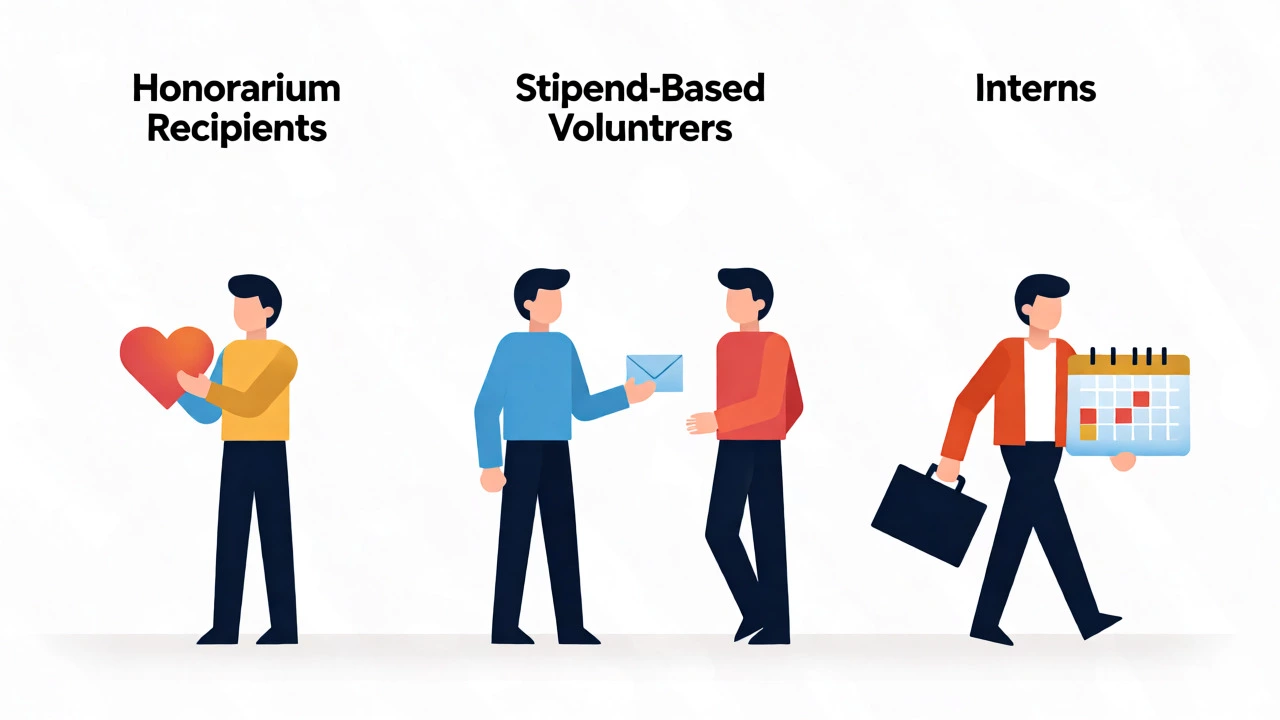
Interns and Trainees
A massive chunk of what people think of as "paid volunteering" is actually unpaid or low-paid interning. The term here is Intern. An intern is a student or recent graduate who works temporarily in an organization to gain practical experience.
Legally, interns occupy a gray area. If the primary benefit of the work goes to the intern (learning skills), they can often be unpaid or receive only a stipend. If the primary benefit goes to the employer (free labor replacing a staff member), they should be paid minimum wage. Many non-profits exploit this ambiguity. If you are doing grunt work-filing, data entry, answering phones-and getting $15/hour, you are effectively a part-time employee, even if the title says "Volunteer Intern." Always check if the role offers mentorship or training. If it doesn't, question whether "volunteer" is the right word.
Service Corps Members
Some government-backed programs create specific titles to bypass the volunteer/employee binary. In the US, Service Corps members (like AmeriCorps VISTA) receive a living allowance. In New Zealand, while less centralized, similar concepts exist under terms like Community Service Workers or Social Enterprise Participants.
These individuals are rarely called volunteers in official documentation. They are "members," "fellows," or "participants." The distinction protects the organization from liability and clarifies the participant's status for social security or benefits eligibility. If you join a structured program with a start date, end date, and a weekly check, look for the specific program name. "AmeriCorps Member" sounds very different from "Volunteer," and carries different prestige and legal weight.
Comparing the Titles: Which One Are You?
To help you identify which label fits your situation, compare the features below. Note that "Paid Volunteer" is almost never the correct formal title.
| Role Title | Payment Type | Taxable? | Typical Commitment | Primary Goal |
|---|---|---|---|---|
| Pure Volunteer | None or Expense Reimbursement | No | Flexible / Casual | Altruism / Community |
| Honorarium Recipient | Small Lump Sum (<$500) | Usually No* | One-off Event | Recognition of Expertise |
| Stipended Volunteer | Regular Allowance | Yes | Long-term / Full-time | Skill Building / Mission Focus |
| Intern | Unpaid or Hourly Wage | Yes (if wage) | Fixed Term (3-6 months) | Career Experience |
| Part-Time Employee | Market Rate Wage | Yes | Contractual Hours | Labor Output |
*Tax rules vary by country. In NZ, honorariums under a certain threshold may not require declaration, but always check with your accountant.
Why the Name Matters More Than You Think
You might wonder, "Who cares what I'm called?" Three groups care deeply: your boss, the tax office, and your future employers.
Your boss cares because misclassifying you creates risk. If you slip and fall while stacking boxes, are you covered by their public liability insurance (volunteers usually are) or their workers' comp scheme (employees definitely are)? Getting the title wrong can leave everyone unprotected.
The tax office cares because stipends and wages are reportable income. If you tell Centrelink or Work and Income you are a "volunteer" but you're actually receiving a $400/month stipend, you might accidentally overstate your benefits or underpay taxes. Be precise. Say, "I am a stipended participant," rather than "I volunteer for free."
Future employers care because "Volunteer" suggests passion, while "Intern" suggests career intent, and "Employee" suggests reliability. If you spent two years running a community garden, calling yourself a "Volunteer Coordinator" understates the management experience. Calling yourself a "Project Lead" (even if unpaid) highlights the skill. Use the title that best reflects the responsibility level, not just the payment method.

How to Ask About Compensation Without Awkwardness
Nobody wants to sound greedy when signing up to help. But clarity prevents resentment later. Here is how to navigate the conversation:
- For short gigs: "Do you cover travel or meal costs?" This signals you expect zero profit but want break-even coverage.
- For speaking roles: "Is there an honorarium budgeted for speakers?" This is professional and standard.
- For long-term roles: "Is this position unpaid, or does it come with a stipend?" This forces the organization to define the structure clearly.
If they hesitate, watch for red flags. If they say, "We can't afford to pay, but we offer great exposure," ask specifically what that exposure looks like. Will you get a letter of recommendation? Mentorship? Networking events? If the answer is vague, treat it as an unpaid volunteer role and adjust your expectations accordingly.
Common Misconceptions Debunked
Misconception 1: "If I get paid, I'm not a volunteer." Not entirely true. You are not a *pure* volunteer, but you are still contributing to a social good. However, legally, you are likely a worker or trainee. Don't let the title confuse the impact. You are still helping.
Misconception 2: "All interns are unpaid." False. The Fair Pay Agreements Act and various labor laws increasingly protect interns. If you are performing productive work that benefits the company, you likely deserve at least minimum wage, regardless of the "volunteer" label attached to the posting.
Misconception 3: "Reimbursements count as income." Generally, no. If you spend $20 on bus fare and get $20 back, that is not income. It is a return of capital. Keep receipts to prove this if audited.
Frequently Asked Questions
Are paid volunteers considered employees?
It depends on the amount and nature of the payment. Small reimbursements for expenses do not make you an employee. However, regular payments that exceed expenses (stipends) or hourly wages often classify you as a worker or employee, entitling you to rights like holiday pay and sick leave. Always check your local labor laws.
What is the difference between a stipend and a salary?
A salary is compensation for labor based on market rates and hours worked. A stipend is a fixed allowance intended to cover living expenses during a period of learning or service, such as an internship or fellowship. Stipends are usually lower than salaries and may not include benefits like health insurance or retirement contributions.
Do I have to pay tax on my volunteer honorarium?
In many countries, small honorariums are exempt from tax up to a certain limit. For example, in New Zealand, honorariums received for community service may be non-taxable if they are modest and irregular. However, larger amounts or regular stipends are generally taxable income. Consult a tax professional for your specific jurisdiction.
Can I claim unemployment benefits if I accept a stipend?
This varies by country. Some welfare systems allow you to keep a portion of earnings or stipends without reducing your benefit amount, known as an "income disregard." Others reduce your benefit dollar-for-dollar. Always declare the stipend to your benefits agency to avoid penalties.
Is "paid volunteer" a real job title?
Rarely. It is mostly a colloquial description. Professional job titles would be "Program Assistant," "Fellow," "Trainee," or "Coordinator." Using precise titles helps clarify expectations regarding duties, liability, and compensation.
Next Steps for You
If you are currently in a role where you receive money but call yourself a volunteer, take ten minutes today to audit your agreement. Look at your last three payments. Are they covering exact receipts? Then you are a volunteer. Are they a flat rate regardless of expenses? You are likely a stipended participant or employee. Update your resume to reflect the accurate title. Instead of "Volunteer," try "Community Program Participant" or "Stipended Fellow." It sounds more professional and accurately reflects the commitment you made.