
Trust Tax Liability & Rate Estimator
Configuration
Analysis Results
| Who Files Form 1041? | |
| Tax Rate Applied | |
| Estimated Tax Owed | |
| After-Tax Cash |
Enter values above to see how trust structure impacts tax liability.
You just inherited money from a trust. The trustee hands you a check, but then asks if you want them to pay the income tax on that money instead of you. It sounds like a great deal-more cash in your pocket without the IRS paperwork. But is it legal? Can a trust actually pay taxes instead of beneficiaries?
The short answer is: it depends entirely on what kind of trust you are dealing with. For most standard family trusts, the answer is no-the tax bill follows the money. If the beneficiary gets the income, the beneficiary pays the tax. However, there are specific structures, particularly charitable trusts which are legal arrangements that provide tax benefits for donors while supporting nonprofit causes, where the dynamics change completely.
Navigating trust taxation is tricky because the Internal Revenue Service (IRS) treats trusts differently than individuals or corporations. To understand who writes the check to the government, we need to look at how the trust was set up, when the income is distributed, and whether the trust has a charitable purpose. Let’s break down the rules so you know exactly where your tax liability lies.
How Trust Taxation Works: The Basic Rule
To understand why a trust might-or might not-pay taxes, you first need to grasp the concept of "flow-through" taxation. Most trusts used for estate planning are called grantor trusts which are tax entities where the person who created the trust is treated as the owner for tax purposes.
In a simple revocable living trust, the trust doesn’t have its own taxpayer identification number for income tax purposes during the grantor's life. Why? Because the IRS sees the trust as just an extension of you. You report the income on your personal Form 1040. When you die, the trust becomes irrevocable. At that point, it gets its own Employer Identification Number (EIN).
Once the trust is irrevocable, it operates under two main filing requirements:
- Form 1041: This is the U.S. Income Tax Return for Estates and Trusts. The trust files this to report its income.
- Schedule K-1: This form tells the beneficiaries how much income they received from the trust.
Here is the critical part: The trust itself usually does not keep the income. It distributes it. When the trust distributes income to you, it issues a Schedule K-1. You take that amount and add it to your personal tax return. The trust gets a deduction for distributing that income, meaning it pays little to no tax on the distributed portion. You, the beneficiary, pay the tax at your individual rate.
So, in this common scenario, can the trust pay the tax instead of you? Technically, the trust could write a check to the IRS on your behalf, but legally, the liability remains yours. The IRS considers it a distribution of principal to you, which might push you into a higher tax bracket anyway. It’s rarely a clean swap.
When the Trust Actually Pays the Tax
There are scenarios where the trust retains the income rather than distributing it. This happens in what is known as an accumulation trust which is a type of trust that keeps income within the trust structure rather than paying it out to beneficiaries immediately.
If the trust document says the trustee must reinvest dividends back into the portfolio, the beneficiary receives nothing that year. In this case, the trust pays the tax on that retained income using Form 1041. Here, the trust is definitely paying the tax instead of the beneficiary. But there’s a catch: trusts have very steep tax brackets.
As of 2026, a trust hits the highest federal income tax rate (37%) at a taxable income level of roughly $15,000. Compare that to an individual, who might earn over $600,000 before hitting that same rate. If the trust holds onto the money, it gets crushed by taxes. That’s why most trustees distribute income-they want the beneficiary to pay the lower tax rate, not the trust paying the high rate.
Charitable Trusts: The Exception to the Rule
This is where your title’s hint about charitable trusts comes into play. A charitable trust is fundamentally different from a private family trust. Its primary goal isn't just to benefit people; it’s to benefit a charity or a public cause.
There are two main types of charitable trusts:
- Charitable Remainder Trusts (CRT): You put assets in, the trust pays you (or other beneficiaries) an income stream for a set period or life, and the remainder goes to charity.
- Charitable Lead Trusts (CLT): The trust pays the charity first for a set period, and then the remaining assets go to your heirs.
In a Charitable Remainder Trust which is an irrevocable trust that provides income to non-charitable beneficiaries for a term of years or life, after which the remainder passes to charity, the trust itself is tax-exempt. It doesn’t pay income tax on its investments because it qualifies as a tax-exempt organization under Section 501(c)(3) of the Internal Revenue Code.
So, who pays the tax? You do. The income you receive from a CRT is taxed to you as ordinary income, capital gains, or tax-exempt interest, depending on the order of distributions defined by the IRS "four-tier" rule. The trust doesn’t pay the tax; it simply passes the liability to you. However, because the trust is tax-exempt, it avoids the double taxation that corporations face.
What about the charity? The charity receiving the remainder never pays tax on that gift. That’s the whole point. So, in the context of a charitable trust, the trust entity itself often pays zero tax, shifting the burden to the human beneficiaries, while the charitable beneficiary pays none.
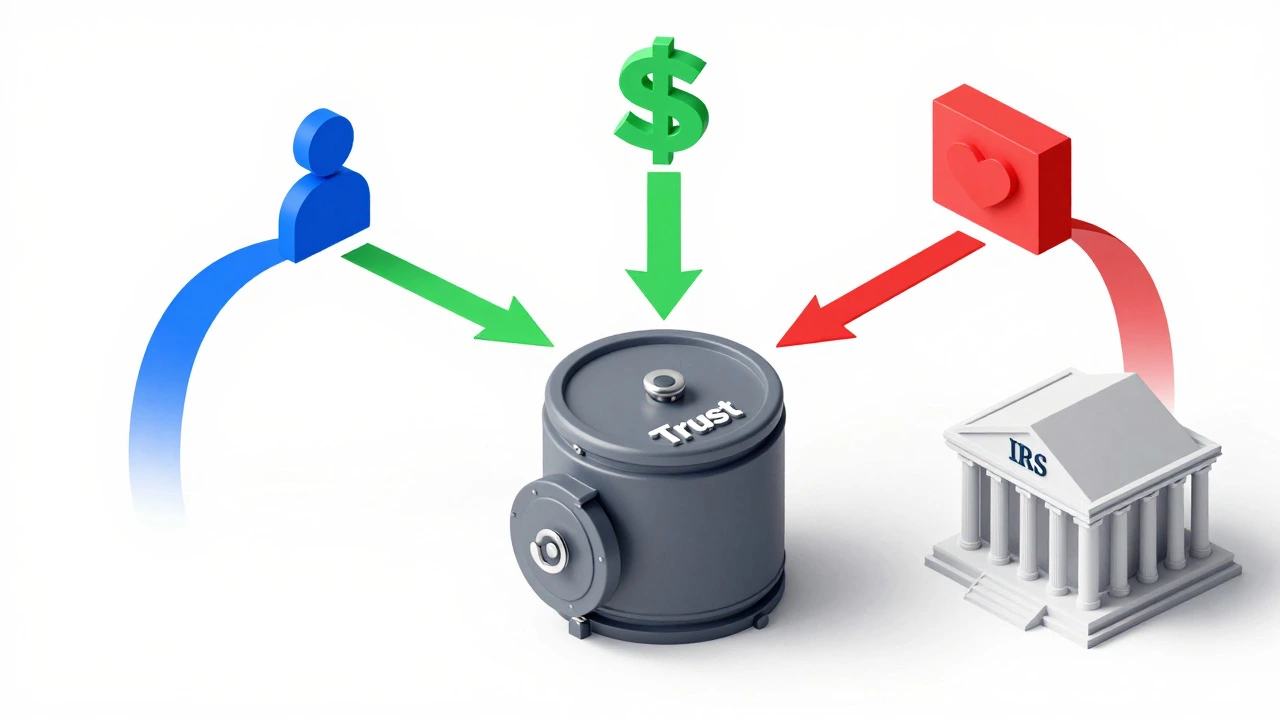
Can the Trust Reimburse Your Tax Bill?
Let’s say you are stuck paying the tax on a large distribution from a private trust. Can the trustee use trust funds to pay your tax bill directly to the IRS? This is a common question among wealthy families.
The answer depends on the language of the trust agreement. Many modern trusts include a "tax reimbursement clause." This clause allows the trustee to distribute additional principal to the beneficiary specifically to cover the income taxes generated by the trust distributions.
Here is how it works in practice:
- The trust distributes $100,000 in income to you.
- You owe $25,000 in federal and state taxes on that income.
- Instead of writing you a second check for $25,000, the trustee writes a check directly to the IRS for $25,000.
From the IRS’s perspective, this direct payment is still considered a distribution to you. It increases your total taxable income from the trust. So, while the trust physically paid the bill, you still report the full amount (income + tax payment) on your return. It doesn’t save you money in terms of tax rates, but it simplifies cash flow management.
However, be careful. If the trust doesn’t have a specific clause allowing this, the trustee might be violating their fiduciary duty. Trustees must treat all beneficiaries fairly. Using trust principal to pay one beneficiary’s taxes might reduce the inheritance available to other beneficiaries, leading to lawsuits.
Comparison: Who Pays the Tax?
| Trust Type | Who Files Form 1041? | Who Pays Income Tax? | Tax Rate Applied |
|---|---|---|---|
| Revocable Living Trust (Grantor) | No (files on 1040) | The Grantor (Owner) | Individual marginal rates |
| Irrevocable Simple Trust | Yes | Beneficiary (via K-1) | Individual marginal rates |
| Complex/Accumulation Trust | Yes | Trust (on retained income) | Compressed trust brackets (high rates) |
| Charitable Remainder Trust | Yes (but tax-exempt) | Beneficiary (on distributions) | Individual marginal rates |
| Charitable Lead Trust | Yes | Trust (usually minimal) | Trust brackets (offset by deductions) |

Pitfalls to Avoid When Managing Trust Taxes
Moving money around between a trust and beneficiaries can trigger unintended tax consequences. Here are three common mistakes people make:
1. Confusing Principal with Income Trusts often distinguish between "income" (dividends, interest) and "principal" (the original asset value). Some states allow trustees to recharacterize principal as income. If done incorrectly, this can shift tax liability unfairly between current beneficiaries and remainder beneficiaries. Always consult a local tax attorney before making these moves.
2. Ignoring State Taxes While the IRS sets federal rules, each state has its own trust tax laws. New York, California, and Texas have complex rules regarding residency and sourcing of income. A trust might owe tax in one state even if the beneficiary lives in another. Don’t assume the federal return is the only one that matters.
3. Missing the Fiduciary Accounting Period Trusts often use a fiscal year that doesn’t match the calendar year. If the trust closes its books on June 30, but you file your taxes on April 15, you might get confused about which year’s income belongs to you. Keep meticulous records of the "distributable net income" (DNI) reported on the K-1.
Next Steps for Beneficiaries and Trustees
If you are a beneficiary wondering if you can offload your tax bill to the trust, start by reading the trust instrument. Look for clauses related to "tax allocation," "reimbursement," or "fiduciary accounting." If those words aren’t there, you likely bear the tax burden alone.
If you are a trustee considering setting up a charitable trust, remember that the tax exemption applies to the trust entity, not necessarily to the income streams paid to humans. Work with a CPA who specializes in estate planning which is the process of arranging for the management and disposal of a person's estate during their life and at or after death. They can model the tax savings against the loss of liquidity.
Finally, always keep communication open. Disputes over who pays the tax are the fastest way to destroy family relationships. Clear documentation and professional advice upfront prevent costly litigation later.
Does a trust pay more taxes than an individual?
Yes, generally. Trusts reach the highest federal income tax bracket at a much lower income level than individuals. As of 2026, trusts hit the top 37% rate at approximately $15,000 in taxable income, whereas single filers may earn over $600,000 before reaching that same rate. This is why most trusts distribute income to beneficiaries, allowing them to pay taxes at their lower individual rates.
Are charitable trusts completely tax-free?
The trust entity itself is often tax-exempt, meaning it doesn't pay income tax on its investments. However, the beneficiaries who receive income distributions from the trust must pay taxes on that income. The charity receiving the final remainder does not pay any tax on the gift. So, while the trust avoids corporate-style taxation, the human beneficiaries still have a tax liability.
Can a trustee pay my income taxes directly to the IRS?
Only if the trust document explicitly allows it. This is known as a tax reimbursement clause. Even if the trustee pays the IRS directly, the IRS views this payment as a distribution to you. Therefore, you must include the tax payment amount in your taxable income, potentially pushing you into a higher tax bracket. It helps with cash flow but doesn't necessarily reduce the total tax owed.
What is the difference between a simple and complex trust for taxes?
A simple trust must distribute all of its income annually and cannot distribute principal or charitable contributions. It gets a deduction for the distributed income. A complex trust can accumulate income, distribute principal, or make charitable contributions. Complex trusts pay tax on any income they retain, subject to the compressed trust tax brackets.
Do I have to pay taxes on gifts received from a trust?
Generally, no. Gifts of principal from a trust are not considered taxable income to the beneficiary. However, if the trust distributes income (like dividends or interest), that portion is taxable. The Schedule K-1 provided by the trustee will clearly separate taxable income from non-taxable principal distributions.